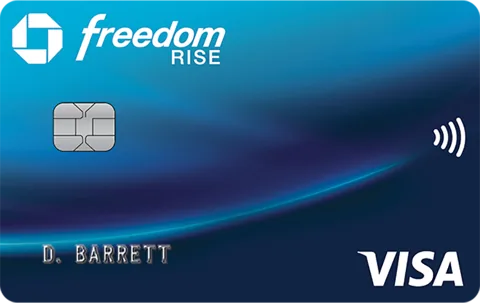
Chase Freedom Rise: a first card at 1.5% cash back, no annual fee, no deposit
An unsecured card for people new to credit, with 1.5% cash back and a $25 credit for autopay; a no-fee 2% card earns $14.40 more after the first year.
The short answer
Chase Freedom Rise is an unsecured cash-back card aimed at people new to credit and students. It has no annual fee and no security deposit, and it earns 1.5% cash back. Approval is still required: being a student or new to credit does not make it certain.
The Studio's credit-building Wallet Score is 95 out of 100, and its one-line fit is "A first unsecured account with no annual fee and documented annual upgrade review." That 95 is not a 95% chance of approval. You would still need a suitable offer and a payment routine you could afford.
For a first card, Julia puts a manageable account ahead of the reward rate, and she would choose Rise as an account she could comfortably manage with the rewards as a useful extra. The comparison is a no-fee 2% card, if you could qualify for one. In Julia's $2,880-a-year example, the $25 autopay credit leaves Rise $10.60 ahead in the first year, and after that the 2% card earns $14.40 more.
What it costs
There is no annual fee and no security deposit. The costs to watch are the ones you can create. Julia would not want an interest charge, an overdraft or an unnecessary purchase to cost more than she had earned.
The comparison is a no-fee 2% card, if you could qualify for one. On the same spending it earns more than Rise after the first year, as the arithmetic below shows. Julia keeps that in perspective: a useful difference, but not a reason to keep applying for accounts you were not ready to qualify for.
If you are thinking of opening a Chase bank account to help your application, that carries its own conditions, covered under the catch. Fees you could not avoid on such an account could undo the appeal of a card with no annual fee.
What it earns
- 1.5% cash back on purchases.
- 3% on eligible restaurant purchases in the first 6 months, up to $6,000 of spending, in the current application.
The restaurant offer is 1.5% extra above the regular rate. Julia would enjoy it on meals she had already planned, then return to the regular rate when the promotion ended. In her comparison she uses the regular 1.5% and keeps the dining extra separate.
The credits, used honestly
The statement credit Julia reviews is $25 for setting up automatic payments. Under the terms reviewed in October 2026, you need to enroll within the first 3 months and stay enrolled for at least 90 consecutive days. The account must also meet the offer conditions when the credit arrives. Enrolling once does not finish the job, so Julia would confirm the enrollment dates and the first withdrawal instead of treating the setup screen as the final step.
The credit is worth its $25 face value once. It improves the first year; it does not permanently change what your purchases earn.
Optional extras get the same scrutiny. A complimentary DashPass period, for example, can turn into a paid subscription if you keep it. Julia decides about a subscription separately from the card: Rise would need to make sense as a basic account with cash back, even without the extra perk.
The catch
Approval comes first. Chase says at least $250 combined in eligible Chase checking or savings accounts can improve some applicants' chances. This is for people who have never had a credit card, including as an authorized user. The accounts must be open before applying, and qualifying funds need to be available within the stated 4-day window. The balance is not required, does not ensure approval and is not a security deposit.
If you are under 21, take care with the ability-to-pay questions: independent income or assets may matter. The law allowing certain co-signers does not mean this issuer offers them. Use the issuer's instructions and report your information honestly.
Autopay needs a look at the settings, because not all automatic payments work the same way. Check which amount you have chosen. For ordinary purchases with a grace period, paying the full statement balance by the due date usually avoids interest. Minimum-payment autopay is a helpful backup, but it is not the same as paying in full.
A small credit limit makes a balance look larger. There is no exact percentage to chase, paying interest is not necessary to show use, and reporting schedules and score effects vary.
The Studio's limitation line adds: "A published soft preview for this exact product was not established; upgrade depends on meeting every condition."
Who it fits
It fits a person new to credit, or a student, who wants an unsecured first account with no deposit and a routine they can afford. Julia would start with a planned $40 monthly bill, enough to learn the routine, and add more planned spending once reading and paying the statement felt familiar.
It may also suit someone who wants the annual upgrade path. Each year, Chase evaluates eligible Rise accounts for a first Freedom Unlimited card. The conditions include keeping the account open, making a purchase within the previous 12 months and satisfactory payment status, and Chase looks at payments to its own accounts and to other lenders. If you have Freedom Unlimited now, or had it before, this automatic path is not available.
An upgrade does not promise a bigger limit, an automatic score increase or the welcome offer for new applicants. It fits less well if you are counting on it: a year passing would not ensure one, and a temporary dining offer on Rise would not make the higher rate permanent.
The arithmetic
Julia's figures use the regular 1.5% rate, with every statement paid in full from expenses your income already covers.
- Start small: a planned $40 monthly bill earns $7.20 a year, and the account can still report your payments.
- A bigger year: $240 a month is $2,880 a year and earns $43.20. Meeting the automatic-payment conditions adds $25, for a first-year total of $68.20.
- Against a no-fee 2% card: the same $2,880 earns $57.60. Rise's first year is $10.60 ahead, excluding any opening offer on the other card. After that, the 2% card earns $14.40 more.
- Small limits: with a $500 limit and a reported balance of $240, utilization is 48%. Paying it down to $60 before reporting would bring that to 12%.
- The upgrade: if $80 of monthly spending is dining, that is $960 a year. Earning 3% instead of 1.5% adds $14.40 a year, and Julia counts it only after actually receiving the upgrade.
Before you apply
On Chase's page, check the current terms of the $25 autopay credit, the restaurant offer for the first 6 months and the conditions of the annual upgrade review. If you are considering a Chase bank account, read its terms alongside the card's, including the $250 combined balance, the 4-day window and any fees.
Julia's last step is the routine: choose the payment amount, check the withdrawal date, leave enough in checking and confirm the first payment posted. That would be a habit worth keeping after the $25 credit had arrived. The Studio checked these terms on October 6, 2026.
Rewritten from Julia’s review script (1,228 words); every figure traces to the script or this card’s record. Terms checked Oct 6, 2026.