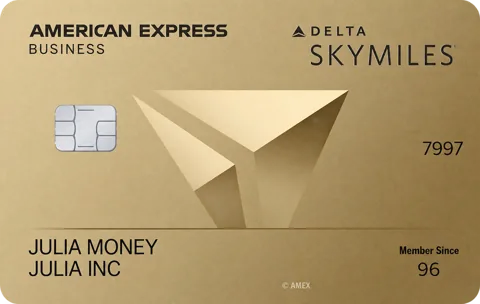
Delta Gold Business: bag savings beat the $150 fee by $30 in Julia's example
A $150 Delta card for travelers who check bags: Julia's example saves $180 on bags, $30 above the fee, while ordinary spending earns more elsewhere.
The short answer
The Delta SkyMiles Gold Business American Express Card earns Delta miles and gives the basic cardholder travel benefits. Julia would consider it if Delta already served her work trips well, and she would use it for genuine business expenses, keeping household purchases separate. The annual fee is $0 for the introductory first year, then $150.
In her example, two domestic Delta round trips with a checked bag each way avoid $180 of bag charges, which leaves her $30 ahead of the fee before other benefits. Moving $10,000 of ordinary purchases onto the card to earn its $200 flight credit gives up $100 in rewards against a 2% card, so it pays only if she would use more than that much of the credit.
The Studio gives it a Business Wallet Score of 56 out of 100. Its fit note reads, "Businesses with recurring eligible Delta trips." It suits a business with recurring Delta trips that checks a bag on them. It fits less well one that travels carry-on only, or one that wants a single card for every invoice.
What it costs
Julia makes the ongoing decision with the renewal cost of $150. A first-year bonus could help, but it would not tell her whether to keep paying later, so this article leaves it out. She compares the card with a no-fee 2% business card, assuming payment in full and no card surcharge.
This is a business account. The business purpose does not remove personal responsibility for its charges, so Julia reads the responsibility agreement before adding employees, keeps records and makes sure the payment money is available.
What it earns
- 2 miles per dollar on eligible direct Delta purchases and restaurants.
- 2 miles per dollar at qualifying U.S. shipping providers and U.S. advertising providers in selected media. Each has its own $50,000 calendar-year cap for that rate.
- 1 mile per dollar on other ordinary purchases, including spending above those caps.
Julia checks the merchant classification: a shipping line on a retailer's invoice is not automatically a purchase from a qualifying shipping provider. The card does not use personal Gold's supermarket category. The Studio's rate card values a mile at 1 cent, the same value Julia uses in her example.
For a trip booked with miles, TakeOff 15 can reduce the eligible Delta award mileage price. You sign in to the linked SkyMiles account and pay the award's taxes and fees with the eligible card. It does not cover partner-operated flights, reduce the taxes themselves or apply to Pay with Miles. A 15% mileage discount does not mean the trip costs 15% less than on another airline, so Julia compares the discounted award with the cash flight her business would choose, including any extra miles or night away.
The credits, used honestly
Checked bags are the benefit in Julia's example. You book the qualifying tickets with this card and include the SkyMiles number. The first-bag waiver needs the basic cardholder's eligible reservation and Delta's operating, marketing and check-in conditions. It can also cover up to 8 companions on the same reservation, but an employee traveling independently does not inherit it because their ticket was charged to your account.
The newer second-bag waiver applies to eligible basic cardholders on qualifying domestic flights. It does not give every companion 2 free bags, normal weight and size limits still apply, and a bag already included in the fare or status saves nothing more. If Julia could travel with a carry-on only, the $180 would disappear from the calculation.
The hotel credit is up to $150 each calendar year on qualifying prepaid hotels or vacation rentals through Delta Stays, paid with the card. Personal Delta Gold's allowance is $100, and neither works at any hotel website. If the Delta Stays price is $30 higher for a comparable booking, a fully usable $150 credit lowers the room cost by only $120. Julia also compares cancellation policy: a cheaper nonrefundable booking is not an equivalent replacement if the client could change the meeting.
After the first card renewal and enrollment, the card offers up to $10 monthly on eligible U.S. rideshare purchases with selected providers. If Julia needed qualifying rides in only 3 months, she would count up to $30, not the annual maximum of $120, and a food delivery from the same app does not count as a ride.
The Studio's rate card carries the bag saving at up to $240 and the hotel credit at up to $150, the largest amounts its test budgets use, and flags both for a check on the issuer's page. It does not count the rideshare credit.
The catch
The $200 Delta flight credit comes after $10,000 of qualifying calendar-year spending, and chasing it can cost more than it returns. Julia imagines choosing where to put $10,000 of planned ordinary purchases, with no card surcharge and payment in full. At 1 mile per dollar the card earns 10,000 miles, worth $100 at 1 cent, while a no-fee 2% card earns $200.
If the whole credit replaced a Delta ticket she would already buy, she comes out $100 ahead on that spending decision. If she used only $60 of the credit before it expired, she finishes $40 behind the cash-back option. She would check the actual expiry and redemption rules before moving invoices, and she would not buy extra stock to reach $10,000.
That result sits on top of the annual-fee decision, so Julia does not subtract the same fee again. If the purchases earned 2 miles instead, the difference would change, so she uses the real categories and the amount still needed to reach the threshold.
Being tied to Delta and earning few miles on ordinary bills limit the result. The card has no renewal companion certificate and no Delta lounge access, so a business that needs either would compare the relevant higher-fee card. The Studio's limitation note reads, "Most spend earns modest miles; fit depends on eligible Delta routes, bags and usable booking credits. No lounge access or renewal companion certificate."
Who it fits
It fits a business with recurring eligible Delta trips, like Julia's client training: two domestic round trips, traveling alone, a standard bag checked on each journey and a fare that would otherwise charge $45 each way.
It fits less well a business that travels with carry-on bags only, flies other airlines, or relies on employees traveling independently, since the bag waiver does not pass to them. It also fits less well one that wants a single card for all invoices: Julia sees the card as a way to reduce the cost of particular work trips, while another card may be better for the invoices between them.
The arithmetic
Julia's bag example has two domestic Delta round trips, a standard bag checked on each journey and a fare that otherwise charges $45 each way.
- Bags: 4 charges of $45 avoided is $180.
- Fee: $180 less the $150 renewal fee leaves $30 ahead, before other benefits or ticket-reward differences.
- Hotel credit: a $150 credit on a booking $30 higher saves $120.
- Rideshare: 3 months at $10 is $30, against the $120 annual maximum.
- Flight credit: $10,000 of purchases earns 10,000 miles, or $100 at 1 cent, against $200 on a 2% card. A fully used $200 credit leaves $100 ahead; using only $60 leaves $40 behind.
Before you apply
On Amex's page, check the fee after the first year, the bag-waiver conditions, the second-bag waiver, the Delta Stays and rideshare credits, the $50,000 caps, the $10,000 threshold and the flight credit's expiry. Julia chooses the card for how she actually packs.
The Studio checked these terms on October 6, 2026, so they may have moved since the video. The two round trips, the $45 bag fee and the rewards comparison are Julia's assumptions to replace with your own.
Rewritten from Julia’s review script (1,336 words); every figure traces to the script or this card’s record. Terms checked Oct 6, 2026.