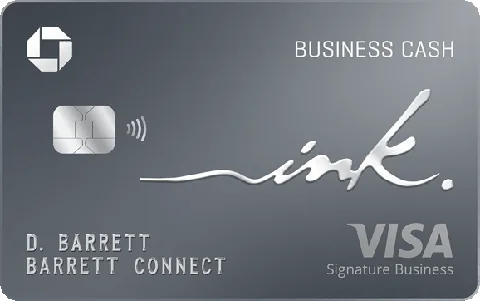
Chase Ink Business Cash: no fee, 5% on office and phone bills up to a cap
No annual fee and 5% on office, internet and phone bills up to $25,000 a year. In Julia's example it earns $520 alone and $700 paired with a 2% card.
The short answer
Chase Ink Business Cash has no annual fee and pays 5 percent on office supplies, internet, cable and phone service, up to $25,000 a year combined. Gas stations and restaurants earn 2 percent up to their own $25,000 cap, and other ordinary purchases earn 1 percent. It rewards recurring office and telecom bills and returns less on everything outside those groups.
In Julia's example, a print-and-design business with $26,000 of spending earns $520 using Ink Cash for everything, the same as a flat 2 percent card. Putting only the qualifying $6,000 on Ink Cash and the other $20,000 on Amex Blue Business Cash earns $700.
The Studio gives it a Business Wallet Score of 68 out of 100, tested on 3 fixed business budgets of $60,000 each. Its fit note reads, "Businesses with recurring office and telecom bills." Its limitation reads, "Category caps and merchant coding; weaker return on unbonused spend." The score tests one card across the whole budget, so a careful pairing can do better.
It suits a business with steady office-supply, internet and phone bills and a payment method its providers accept at the same price. It does not suit a business that would run all of its purchases through the card, because ordinary spending earns only 1 percent.
What it costs
There is no annual fee. Julia pays in full and avoids extra card-payment fees, so interest and fees do not enter the comparison.
What the card is compared against matters here. A flat 2 percent card earns the same $520 on Julia's whole budget. Amex Blue Business Cash also has no annual fee and earns 2 percent on the first $50,000 of eligible purchases each calendar year, then 1 percent, and her business stays below that cap.
Two costs sit outside the card. If paying a phone bill by card removes an autopay discount, the loss comes out of the rewards: $12 more a month is $144 a year. And Ink Cash charges a foreign transaction fee, so a card without one can cost less on purchases abroad even when Ink shows a bonus category.
What it earns
Ink Cash earns by group, and each group has its own cap:
- 5 percent on office supplies, internet, cable and phone service, on the first $25,000 combined each account anniversary year.
- 2 percent at gas stations and restaurants, on a separate combined $25,000 each account anniversary year.
- 1 percent on other ordinary purchases, and on anything above either cap.
The reset follows your account anniversary, not automatically January 1. Rewards are tracked as Ultimate Rewards points, and at the ordinary cash conversion 100 points equals $1. The Studio values a point at 1 cent.
The credits, used honestly
Ink Cash has no statement credits to count; the Studio's rate card lists no benefits beyond its earning rates. The things to value honestly are how the rewards are paid and the introductory offer.
If you hold an eligible separate Chase card with transfer access, travel redemptions become possible too, but Julia would include that card's fee and value the points against a trip you would actually book.
The 0 percent introductory period on purchases lasts 12 months from account opening. It can help with a planned purchase and a workable payoff schedule, but it does not raise the reward value, and it is not the advertised rate for a balance transfer. Under the business-card terms, missing a required payment can end the introductory rate, so make every minimum payment and check the regular rate.
The catch
The first catch is merchant coding. Printer paper from an office-supply store can qualify, but the same paper at a general retailer does not turn that store into an office-supply merchant. A software subscription is not automatically internet or phone service because you use it online. What the merchant is classified as matters.
The second is price. If supplies cost $1,000 at one store and $950 elsewhere, the 5 percent reward on the higher price only brings it down to $950, which the cheaper seller already matches before any reward. Julia would choose the better total price rather than force a purchase into the category.
The third is the cap. Each group's cap is shared by all spending in that group, so check how much allowance remains before a large supply order.
The last is liability. A sole proprietorship can be a real business, but the application still needs accurate information and credit approval, and Ink's terms include personal responsibility for the balance. An EIN does not remove it.
Who it fits
It fits a business with recurring bills in the 5 percent group, such as the $2,400 of internet and phone plus $3,600 of office supplies in Julia's example, and a way to pay them that the provider accepts without a higher price. It fits more fully where the owner can manage 2 statements and payment setups, so the remaining spending goes to a card paying 2 percent.
It fits less well a business that would use Ink Cash for everything, since in Julia's example that only ties a flat 2 percent card, or one that cannot reliably manage two cards. Julia would not accept extra rewards at the cost of missed payments.
The arithmetic
Julia's example is a print-and-design business with $26,000 of annual spending, paid in full.
- $2,400 of internet and phone bills plus $3,600 of qualifying office supplies is $6,000 at 5 percent: $300.
- $2,000 of gas and restaurants at 2 percent: $40.
- The other $18,000 at 1 percent: $180.
- Total on Ink Cash alone: $520, the same as a flat 2 percent card.
The pairing puts the qualifying $6,000 on Ink Cash for $300 and the remaining $20,000 on Amex Blue Business Cash at 2 percent for $400. That is $700 altogether, $180 more than either card alone. Gas and restaurants could go on either card, because both earn 2 percent there and the business reaches neither cap.
The cap changes the sum. Suppose $24,000 is already spent in the 5 percent group this anniversary year and a new qualifying purchase costs $4,000. Only $1,000 fits below the cap, earning $50, and the other $3,000 earns $30 at 1 percent. That is $80, not the $200 the headline rate suggests.
Before you apply
Check Chase's page for the current categories and caps, the introductory rate and its end date, the foreign transaction fee, and whether your providers accept card payment without taking away a discount. Chase's current language says a welcome offer may be unavailable if you have had this card or another no-annual-fee Chase business card, so check your eligibility before counting one.
Julia reviewed these terms in October 2026, and the Studio's record was checked on October 6, 2026. Terms may have moved since the video, and every figure in her example is an assumption about one small business, so replace it with your own.
Rewritten from Julia’s review script (1,188 words); every figure traces to the script or this card’s record. Terms checked Oct 6, 2026.