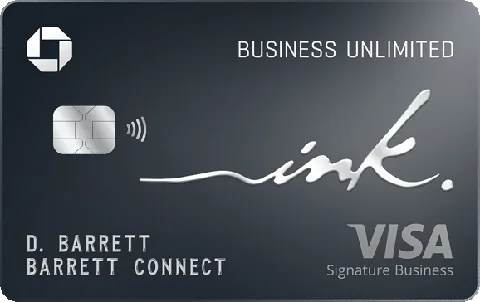
Chase Ink Business Unlimited: a flat 1.5% with no category routine
No annual fee and a flat, uncapped 1.5%. In Julia's example a capped 2% card earns more at $72,000, and Unlimited earns more at $120,000.
The short answer
Chase Ink Business Unlimited has no annual fee and pays an uncapped 1.5 percent on ordinary eligible purchases, with no category routine to manage. Its trade is simplicity for rate. In Julia's example, a business spending $72,000 a year earns $1,080 on it, which is $140 less than the $1,220 it would earn on Amex Blue Business Cash.
The comparison flips as the budget grows. At $120,000 of ordinary spending Unlimited earns $1,800 against $1,700, and the two cards earn the same $1,500 at $100,000.
The Studio gives it a Business Wallet Score of 67 out of 100. Its fit note reads, "Simple cash return across varied business purchases." Its limitation reads, "1.5 percent flat rate can trail higher-rate competitors."
It suits a business with varied ordinary purchases and no bonus categories worth tracking, particularly above $100,000 a year. It does not suit a business that wants more than 1.5 percent on a modest budget, where a capped 2 percent card earns more.
What it costs
There is no annual fee. Julia pays in full and assumes suppliers accept either card without a surcharge, so the comparison is about rewards alone.
The cost to weigh is the rate you give up. Unlimited is measured against Amex Blue Business Cash, which has no annual fee and earns 2 percent on the first $50,000 of eligible purchases each calendar year, then 1 percent. A suitable uncapped 2 percent card also deserves comparison, if one is available.
Two costs can sit outside the card. A supplier that adds a surcharge for card payment can cost more than the reward earns, and Ink Unlimited charges a foreign transaction fee, so a business card without one can cost less for international suppliers or travel.
What it earns
Ink Unlimited earns 1.5 percent on ordinary eligible purchases, with no cap. The Studio's rate card lists a base rate of 1.5 and values a point at 1 cent. Rewards are recorded as Chase Ultimate Rewards points, and at the ordinary cash conversion 1.5 points per dollar is worth 1.5 percent.
Julia leaves limited promotional categories, including qualifying Lyft purchases, out of her comparison. She checked these terms in October 2026.
Travel redemptions are a separate calculation. With an eligible separate Chase account that allows transfers, you may be able to combine points and transfer to travel partners. If a net 1.5 cents per point were possible on business travel you would otherwise buy, 1.5 points per dollar would return about 2.25 percent in travel value. Subtract award taxes and fees, check the transfer ratio and compare with a paid trip you would realistically choose. If you need an annual-fee card to make transfers, count that fee too.
The credits, used honestly
The Studio's rate card lists no statement credits for Ink Unlimited. Two other features need honest valuation: the rental car coverage and the introductory 0 percent offer.
Eligible rental coverage can be primary when you rent for work. To use it, you charge the entire rental to the card, decline the rental company's collision coverage and follow the benefit rules. That can change which card you use for the rental even if another card earns more overall. Check the vehicle and the covered losses first, because collision and theft coverage does not settle every possible expense after an accident.
Unlimited currently offers 0 percent on purchases for 12 months from account opening. The minimum payment is not a payoff schedule made for a particular purchase, so check your actual expiration date, the regular APR and the amount you need to pay. The business-card terms can end the introductory rate after a missed minimum payment. A promotion that makes year 1 look free is not a reason to buy inventory.
The catch
Start with the invoice. If a supplier added 3 percent to a $1,000 invoice, the business would be charged $1,030. Unlimited's 1.5 percent reward would be $15.45, against a $30 fee, leaving the business $14.55 worse off than with the fee-free payment route. Julia might still prefer the card for timing or convenience, but she would want to know what that choice cost.
The $100,000 crossover describes only these 2 products. It does not make 1.5 percent the universal winner for a bigger business, and it ignores bonuses, promotional categories and different fees.
Employee cards can help track expenses, but their purchases still create bills on your account. Ink's terms include personal responsibility for balances, and business status and an EIN do not automatically protect you from that agreement.
Do not assume a second no-fee Ink card brings a second welcome bonus. Current Chase language can restrict eligibility based on previous no-annual-fee Chase business cards, so keep any bonus separate from recurring earnings.
Who it fits
It fits a business whose ordinary spending is large and varied enough for an uncapped rate to matter. In Julia's example that is $120,000 a year, past the $100,000 crossover, where Unlimited earns $100 more than Blue Business Cash alone. It also fits an owner who wants no category routine and whose suppliers take card payment at the same price.
It fits less well a business near the $72,000 of Julia's first example, where the capped 2 percent card earns $140 more, or one whose suppliers add card surcharges. Within the caps, Ink Business Cash earns higher rates on eligible office-supply, telecom, gas and restaurant purchases, so Julia would consider pairing the two when the extra reward mattered and the bookkeeping stayed manageable.
The arithmetic
Julia's example is an equipment-service business spending $72,000 a year on ordinary purchases, paid in full, with no supplier surcharge.
- Amex Blue Business Cash: $50,000 at 2 percent is $1,000, plus $22,000 at 1 percent is $220, for $1,220.
- Ink Unlimited: $72,000 at 1.5 percent is $1,080.
- Amex leads by $140.
At $120,000, Amex earns $1,000 below its cap and $700 above it, for $1,700. Unlimited earns $1,800, putting it $100 ahead. At $100,000 the single-card totals meet at $1,500 each: Blue Business Cash earns more below that point and Unlimited earns more above it.
Using both at $120,000 puts the first $50,000 on Amex for $1,000 and the remaining $70,000 on Unlimited for $1,050. That is $2,050 combined, $250 more than Unlimited alone, and Julia would decide whether a second account and tracking Amex's calendar-year cap were worth it.
For a planned $6,000 equipment purchase under the 0 percent offer, 10 payments of $600 would clear it before other charges.
Before you apply
Check Chase's page for the current rate, the introductory period and its end date, the foreign transaction fee, the rental coverage rules and whether you are eligible for any welcome offer. Ask your suppliers whether they surcharge card payments.
Julia checked these terms in October 2026, and the Studio's record was checked on October 6, 2026. Terms may have moved since the video, and her $72,000 and $120,000 budgets are assumptions to replace with your own.
Rewritten from Julia’s review script (1,223 words); every figure traces to the script or this card’s record. Terms checked Oct 6, 2026.