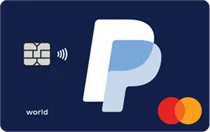
PayPal Cashback Mastercard: 3% via PayPal checkout, 1.5% on other purchases
A no-fee card paying 3% on eligible PayPal checkout and 1.5% elsewhere; used beside a 2% card, it adds $60 a year on $6,000 of PayPal orders.
The short answer
The PayPal Cashback Mastercard is a credit card issued by Synchrony Bank, with no annual fee. It earns 3% on eligible online purchases made through your PayPal account when you choose this card to pay, and 1.5% on other eligible purchases. The same purchase on the same card can earn half as much, depending on which button you use at checkout.
The Studio's one-line fit is "PayPal checkout purchases, especially as a second card." Its Wallet Score is 62 out of 100 on the everyday card test. Julia's useful version of the card is specific: purchases you would make anyway, at competitive prices, through eligible online PayPal checkout.
Beside a no-fee 2% card, it adds $60 a year on $6,000 of PayPal orders. As your only card, it needs more than a third of your spending to earn 3% to beat a flat 2% card. It fits less well if you rarely use PayPal, spend abroad or want one card for everything.
What it costs
There is no annual fee, but two smaller charges can eat into the gain. The current agreement lists a monthly paper statement fee of $1.99 when a paper statement is sent and the balance exceeds $2.50. Choosing electronic statements avoids it. If it applied in all 12 months it would cost $23.88, a noticeable piece of the $60 Julia is trying to gain.
The card also charges a 3% foreign transaction fee, including on qualifying transactions outside the United States even when they are charged in dollars. That could undo the rewards very quickly, so Julia would check the merchant and use a suitable card with no foreign transaction fee for travel.
The comparison throughout is a no-fee 2% card. Interest is the cost to avoid: Julia would set reminders or autopay for the full statement balance, because paying interest to earn another 1% would not help.
What it earns
- 3% on eligible online purchases paid through PayPal, when you choose this card as the payment method.
- 1.5% on other eligible purchases, including a card number typed directly into a store's checkout.
Adding the physical card to a different mobile wallet does not get the PayPal result: an ordinary tap with that wallet generally earns the card's 1.5%. An authorized user cannot add their card to their own PayPal account under the current setup, so their eligible purchases generally earn 1.5%.
The Studio does not pretend every purchase earns 3%. Its test assumes eligible PayPal checkout handles half of online shopping, so online spending is modeled at a blended 2.25%. Its limitation line reads: "Only 50 percent of online retail and none of physical retail modeled as eligible PayPal checkout." That leaves much of the basket at 1.5% and limits the score.
The rewards are cash. Once they are available, you redeem them through your linked PayPal account, with no minimum redemption amount. With a PayPal Balance account you can use the redeemed rewards there or transfer them onward. Without one, you can transfer them to a bank account or debit card linked to PayPal.
The credits, used honestly
The card has no recurring statement credits. Four things sit near the idea of a credit, and each needs care.
- Redeemed rewards: moving cash back into PayPal is not the same as paying your Synchrony bill. Julia would still make the required credit card payment.
- Returns: if you return a purchase, the rewards could be reduced. She would wait for returns to settle before treating every dollar in the rewards total as money she would keep.
- Merchant offers in the PayPal app: some can add savings, but check the activation and purchase requirements before counting them. An offer has to fit something you already wanted to buy.
- Expiry: the Studio's record shows no fixed expiration for the rewards while the account remains open and in good standing.
The catch
The checkout button is the catch. Seeing the PayPal button does not tell you which payment method is selected inside it, so Julia would make sure it is this card and not her bank account, PayPal balance or another saved card. If you type the card number directly into a store's checkout instead, the purchase earns 1.5%.
The higher rate also depends on how much of your shopping reaches that button. The Studio's own review note says the PayPal-checkout share of online shopping is an assumption, so look at your own orders before relying on it.
On protection, the Studio's two checks found no payable coverage. The current full benefits guide lists no accidental purchase damage reimbursement and no covered-illness trip-cancellation reimbursement, so the card earns no protection points in its rating.
Who it fits
It fits a household that already pays for online orders through PayPal, at stores that accept it, and keeps a flat card for everything else. Julia would save the right payment method, check it before paying and redeem the cash back periodically. If that covers a meaningful share of her family's shopping, she would consider the card alongside a stronger one for everything else.
It fits less well if you rarely reach that PayPal button, in which case Julia would be happy keeping a simpler setup. It also fits less well as a card for the whole family, because authorized users do not get the PayPal rate, and for travel, where the 3% foreign transaction fee applies.
The arithmetic
Julia's examples use a $240 desk chair and a family that sends $500 a month through PayPal.
- One purchase: the $240 chair paid with the card number typed into the store's checkout earns $3.60 at 1.5%. Choosing PayPal and selecting this card earns $7.20 at 3%. Same chair, same price, another $3.60.
- As a second card: $500 a month through eligible PayPal checkout is $6,000 a year, and the card earns $180 on it. A no-fee 2% card would earn $120 on the same spending, so PayPal improves the result by $60 a year, not $180.
- As the only card: add $12,000 of purchases that do not qualify, earning $180 at 1.5%. The PayPal card returns $360 on $18,000, exactly what a flat 2% card returns. The higher online rate is cancelled out by the lower rate on everything else.
- Splitting the roles: keep the flat card for the $12,000 and use PayPal only for the qualifying orders, and the two earn $420 between them. That is the same $60 improvement.
- Rule of thumb: every $100 moved from a 2% card into eligible PayPal checkout earns 1 extra dollar, and every $100 moved into ordinary PayPal card purchases loses 50 cents.
- A weaker year: if only $4,000 of the $18,000 goes through eligible PayPal checkout, the card earns $330 altogether against $360 for the flat card. That is $30 behind.
- Price first: the $240 chair costs $232.80 after 3% back. The same chair at $225 from another trustworthy store costs $220.50 after 2%, which saves $12.30. Julia would not pay $15 more just to earn the higher percentage.
- The paper statement fee: $1.99 in each of 12 months is $23.88.
Before you apply
Julia would check the last few online orders. If the stores already accept PayPal and the extra cash back is worth another account, the card has a use; if you rarely use PayPal, a simpler setup remains reasonable. On the issuer's page, confirm the 3% and 1.5% rates, the paper statement and foreign transaction fees, and the activation rules for any merchant offer you plan to count. The Studio checked these terms on October 6, 2026.
Rewritten from Julia’s review script (1,294 words); every figure traces to the script or this card’s record. Terms checked Oct 6, 2026.