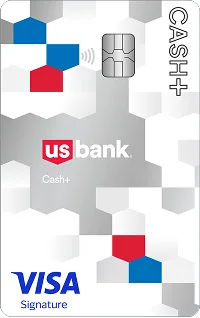
U.S. Bank Cash+: 5% on two bill categories, if you activate them every quarter
A no-fee card paying 5% on two chosen categories, up to $2,000 a quarter combined; it fits bills that accept cards without a fee.
The short answer
U.S. Bank Cash+ is a cash-back card with no annual fee. As checked in October 2026, it lets you choose and activate 2 categories that earn 5%. They share a cap of $2,000 in combined eligible purchases each quarter, and spending above it earns 1%. Home utilities and TV, internet and streaming are among the choices, and cell phone providers are a separate choice.
In Julia's example, $375 a month of utility and internet bills, $1,125 a quarter, earns $56.25 at 5%, against $22.50 on a 2% card. That is $33.75 more a quarter, or $135 a year, before checking the fees and discounts on the bills themselves. Whether the gain survives depends on how each bill is paid: a card-payment fee or a lost bank-payment discount can erase it.
The Studio's one-line fit is "Predictable utility and mobile-phone bills without processing fees."
What it costs
There is no annual fee, and the Studio's record shows no membership cost. The costs to check sit on the bills. A utility that charges $6 a month to pay by card adds $18 a quarter, and a bank-payment discount lost by moving to the card counts against the reward.
Julia compares the card with a 2% card and with paying from the bank account. If both cards incur a card-payment fee, their difference stays the same, but paying from the bank for free is a third option to price. The Studio's score assumes the bills accept card payments without an extra charge or lost discount; if yours do not, subtract that cost first.
What it earns
- 5% on the 2 categories you choose and activate, sharing $2,000 of combined eligible purchases each quarter, then 1%.
- 2% in one selected everyday category.
- 1% on other eligible purchases.
- 5% on qualifying prepaid travel through its Travel Center, which does not give every direct travel purchase 5%.
The cap is not $2,000 for each category; both selected categories share it. Selecting utilities and internet does not automatically give the phone bill the same rate. The available categories can change, so review them each quarter rather than assuming last quarter's setup continues.
The credits, used honestly
The card has no statement credits, and the Studio's record lists no benefits. What it pays is cash back, redeemed as a statement credit at face value. Two limits apply: the redemption minimum is not fixed in the issuer's material, which says amounts vary, and the rewards have a fixed expiration of 36 months even while the account is open.
The nearest thing to a credit is the discount a bill may already carry for paying from a bank account. That discount can beat the reward. Julia prices each bill separately, and the right setup does not have to put every bill on the same card.
On protection, the Studio found no payable coverage for either of its checks, a damaged purchase and a cancelled trip, so the card earns no protection points in its rating.
The catch
The rates need enrollment each quarter. Set a reminder and confirm the selections took effect. On Julia's $1,125 quarter, 1% instead of 5% pays $11.25 rather than $56.25, so $45 is gone, and one missed quarter cuts the $135 yearly gain to $90.
Each bill also has to reach the issuer under a code that qualifies for the category. Use the current category definitions and check the first posted reward before moving a whole payment routine.
After the cap, a 2% card beats the 1% fallback on additional eligible purchases, so you could switch those purchases if tracking is manageable. There is no need to buy more to make use of a category.
The public page advertises a welcome bonus, and offers can change. Julia keeps it separate from what she expects in each later year: the recurring-bill reward has to be worthwhile without another welcome offer.
Who it fits
It fits a household with a few predictable bills, such as utilities, internet or a phone, that take card payments without a fee or a lost discount, and that can manage a quarterly activation. Julia would consider Cash+ for a few bills she could manage comfortably, rather than expect its top percentage on the whole budget.
It fits less well a household whose bills charge for card payments or reward bank payments, one that is unlikely to remember the quarterly step, or one whose eligible spending runs well past $2,000 a quarter.
On the Studio's everyday card test, Cash+ scores 53 out of 100. The test puts most weight on value after costs across 3 household budgets, then reward flexibility, effort and 2 protections. Utility and phone rewards help, but quarterly activation, spending caps and the fixed expiration make it less effortless than a flat-rate card.
The arithmetic
Julia's bills are $260 a month for eligible utilities and $115 for eligible internet and streaming, $375 a month or $1,125 a quarter.
- Cash+ at 5% returns $56.25 against $22.50 on a 2% card, an extra $33.75 for the quarter and $135 over 4 quarters.
- The utility bill with a $6 card fee: 5% on $260 earns $13 a month, and subtracting the fee leaves an advantage of $7 over a fee-free bank payment that earns no reward.
- The internet bill: paying from the bank with a $10 discount costs $105. Paying $115 by card earns $5.75 back, leaving a cost of $109.25, which is $4.25 more. Julia would keep the bank-payment discount.
- A bigger quarter: with $2,600 in the 2 categories, the first $2,000 earns $100 and the remaining $600 earns $6 at 1%. That is $106 against $52 on a 2% card, so Cash+ adds $54.
- A missed activation: $11.25 instead of $56.25, which is $45 less and a yearly improvement of $90.
Before you apply
On U.S. Bank's page, confirm the list of categories you can choose and the quarterly cap. Check a couple of bills you already pay for fees and bank-payment discounts, activate suitable categories and verify the first rewards. The Studio checked these terms on October 6, 2026.
Rewritten from Julia’s review script (1,048 words); every figure traces to the script or this card’s record. Terms checked Oct 6, 2026.