Which no-annual-fee card returns the most on Uber and Lyft rides
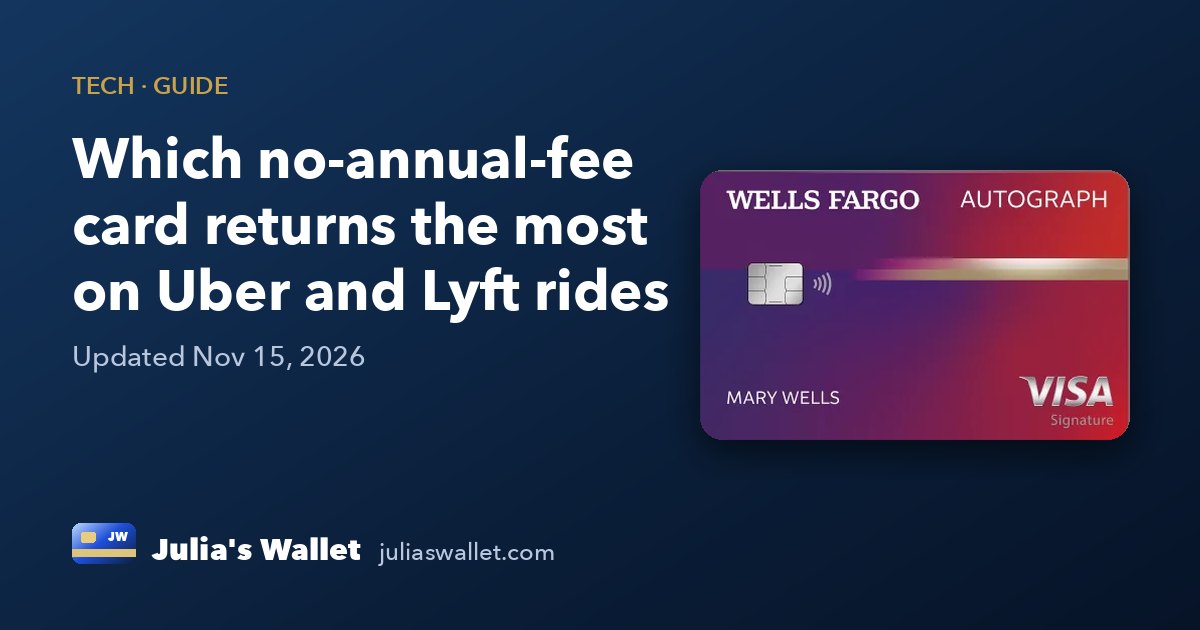
Wells Fargo Autograph returns $30 on $1,000 of rides that count as transit; Robinhood Gold pays the same rate but needs a $50 yearly membership.
The short answer
On $1,000 of Uber and Lyft rides in a year, Wells Fargo Autograph returns $30 when the rides count in its 3-point transit category, against $20 on a flat 2 percent card. Robinhood Gold also pays 3 percent, or $30, but it requires a $50 yearly Gold membership. If rides were all you put on Robinhood Gold, $30 in rewards minus the $50 membership would leave you $20 down.
The other three cards earn less on the same $1,000. Chase Freedom Unlimited pays 1.5 percent, or $15. Capital One Savor pays 1 percent, or $10. Citi Custom Cash pays 1 percent, or $10, unless rides post as select transit, one of its eligible categories, and are your top category in that billing cycle. Citi Custom Cash is also closed to new applicants.
Rides are rarely the biggest line in a household budget, so the card that wins on rides still has to suit the rest of your spending. The sections below show how each card does on $1,000 of rides and in Julia's worked example for each card.
How much does each card return on $1,000 of rides?
The same $1,000 of rides, at each card's stated rate and 1 cent per point. Terms checked October 6, 2026.
- Wells Fargo Autograph: 3 points per dollar if the rides count as transit, so $30. If they post as ordinary purchases, 1 point per dollar, so $10. No annual fee.
- Robinhood Gold Card: 3 percent on eligible purchases, so $30. There is no annual card fee, but the usual required Gold membership costs $50 a year.
- Chase Freedom Unlimited: 1.5 percent on ordinary purchases, so $15. No annual fee.
- Capital One Savor: 1 percent on purchases outside its bonus categories, so $10. No annual fee.
- Citi Custom Cash: 1 percent, so $10, unless rides post as select transit and are the top eligible category that cycle. No annual fee. Existing cardholders only.
As a benchmark, a flat 2 percent card such as Citi Double Cash returns $20 on the same rides.
Julia's Wallet Scores, out of 100 on her everyday card test, rank the five cards differently, because the score weighs value after costs across three household budgets first, then reward flexibility, effort and two protections:
- Robinhood Gold Card: 89
- Capital One Savor: 76
- Chase Freedom Unlimited: 75
- Wells Fargo Autograph: 67
- Citi Custom Cash: 63
Does an Uber or Lyft ride count as transit on Wells Fargo Autograph?
Wells Fargo Autograph gives 3 points for each dollar in six groups: transit, gas, restaurants, travel, phone plans and popular streaming services. Everything outside those groups gets 1 point. Whether a given ride earns 3 points depends on how Wells Fargo classifies the merchant, so Julia's approach with Autograph is to confirm the merchant classification rather than assume it.
Autograph's case rests on more than rides. In Julia's worked example for Autograph, a family spends a year as follows:
- $6,000 at restaurants
- $4,000 on travel
- $3,000 on gas and transit
- $360 on streaming
- $1,440 on a phone plan
That is $14,800 in Autograph's categories, earning $444. Another $10,000 of other purchases earns $100. Autograph's total is $544, against $496 for Double Cash on the same $24,800, a lead of $48.
On its own, Wells Fargo Autograph beats a flat 2 percent card only when more than 50 percent of your spending lands in its categories. In the same example, Autograph keeps its categories and Double Cash takes the other $10,000 for $200. The pair returns $644, which is $148 more than Double Cash alone.
Wells Fargo Autograph charges no foreign transaction fee, and qualifying transit abroad can still earn 3 points.
Is Robinhood Gold's $50 membership worth it for rides?
Robinhood Gold pays the same 3 percent on rides as Autograph, and on ordinary purchases too. Because the $50 membership is a yearly cost of the account, Robinhood Gold makes sense as a card for most of your spending rather than for rides alone.
In Julia's worked example for Robinhood Gold, a family puts $6,000 on restaurants and $24,000 on other purchases. That is $30,000 at 3 percent, or $900. After the $50 membership, the family keeps $850. A 2 percent card alone earns $600 on the same budget, $250 behind Robinhood Gold.
What Robinhood Gold asks of you:
- Julia counts its rewards at 1 cent each, taken as cash into a Robinhood brokerage account. You need that account, though you do not have to invest.
- Robinhood says Gold accounts opened before July 1, 2026 carry no foreign transaction fee, while accounts opened after that date are charged 3 percent on purchases in a foreign currency. That matters if you ride abroad.
Robinhood's Platinum card has a monthly Waymo credit, but rides paid for through the Uber app are not eligible for it. Platinum's $695 annual fee puts it outside this guide.
Where do Savor, Freedom Unlimited and Custom Cash fit?
None of these three cards names rideshare as a category, though Custom Cash's list includes select transit. Each is built for other spending.
Chase Freedom Unlimited pays 3 percent at restaurants and drugstores, while most other purchases, rides included, get 1.5 percent. On $1,000 of ordinary purchases that is $15, against $20 on a 2 percent card. In Julia's worked example for Freedom Unlimited, a family spends $300 a month on dining and $50 at drugstores. Those $4,200 a year earn $126. Adding $18,000 of ordinary purchases at 1.5 percent brings Freedom Unlimited's year to $396, against $444 on Double Cash. Giving Freedom Unlimited only its 3 percent categories and Double Cash the rest brings the pair to $486.
Capital One Savor pays 3 percent on food and fun: qualifying supermarkets, restaurants, entertainment and popular streaming. Most other purchases get 1 percent, so rides earn $10 per $1,000. In Julia's worked example for Savor, $12,600 in Savor's categories earns $378, and $8,400 of ordinary spending earns $84. That gives Savor $462 for the year, against $420 on a flat 2 percent card. With a 2 percent card covering the ordinary spending, the pair earns $546.
Citi Custom Cash pays 5 percent on the first $500 in your top eligible category each billing cycle, then 1 percent. The eligible categories are restaurants, gas stations, grocery stores and drugstores; select travel, select transit and select streaming services; and home improvement stores, fitness clubs and live entertainment. Rides earn 5 percent only if Citi counts them as select transit and they are your biggest eligible category in that cycle; otherwise they earn 1 percent. As with Autograph, how Citi classifies the ride merchant decides it. In Julia's worked example for Custom Cash, $500 of groceries in one cycle earns $25, against $10 on a 2 percent card. Over 12 cycles that is $300 against $120. Citi closed Custom Cash to new applications on May 28, 2026.
Which card should take the rides?
The deciding question is how much of your spending each card rewards.
- If your rides post as transit and you also spend on dining, travel, gas, streaming or a phone plan, Wells Fargo Autograph returns $30 per $1,000 of rides with no annual fee, and a 2 percent card can cover groceries and ordinary purchases.
- If you want one card for nearly everything and accept the brokerage account and the $50 membership, Robinhood Gold pays 3 percent broadly. In Julia's example for Robinhood Gold, that came to $850 kept on $30,000.
- If you already carry Chase Freedom Unlimited, Capital One Savor or Citi Custom Cash for their own categories, rides on any of them earn less than on a 2 percent card. Moving $1,000 of rides from Freedom Unlimited ($15) to a 2 percent card ($20) adds $5. Moving them from Savor or Custom Cash ($10 each) adds $10.
On rides alone, the gaps are a few dollars a year. Booking extra rides to chase a rate costs more than it returns; a reward only pays off on a trip you were taking anyway.
Before you act
On each issuer's page, confirm the terms that decide the ride result:
- Wells Fargo Autograph: whether rideshare merchants count as transit for 3 points.
- Robinhood Gold Card: the yearly Gold membership cost, the brokerage account requirement and the foreign transaction fee for your account's opening date.
- Chase Freedom Unlimited: the 1.5 percent base rate. Chase has also announced changes to how points can be redeemed through Chase Travel for some Freedom cardmembers, so read Chase's current page.
- Capital One Savor: which categories earn 3 percent on your version of the card.
- Citi Custom Cash: whether your rides post as select transit, and any notice about your existing account.
On foreign fees, Wells Fargo Autograph charges none, and Capital One Savor charges none. For Chase Freedom Unlimited, read Chase's fee table; for Citi Custom Cash, read Citi's.
Your last statement shows how your ride merchants are listed and how much you spend on rides compared with everything else. Every figure here assumes the balance is paid in full, since interest outweighs any difference in rewards. Terms checked October 6, 2026; rates and categories may have moved since.
The cards in this guide
Keep reading
- Blue Cash Preferred pays 6% on select streaming; three cards pay 3% and two pay 1%
- A flat 2 percent card or Savor for subscriptions: why the streaming gap is small
- Apple Card or a flat 2 percent card: what a year of Apple Pay spending earns
- Apple Card or PayPal Cashback Mastercard: which earns more on your online orders
Terms checked Oct 6, 2026. Not financial advice.