Where a store credit card works, and how its Visa or Mastercard version differs
A store-only card works only at its own store. A Visa or Mastercard version can work elsewhere. Julia pairs a store card with an everyday card.
The short answer
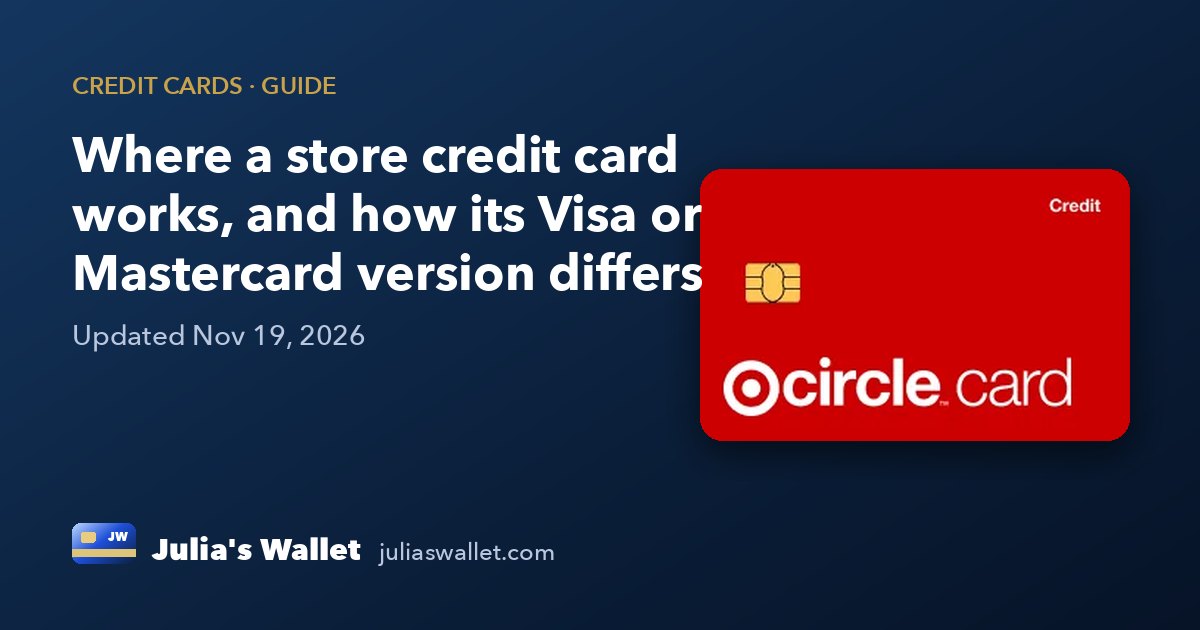
A store-only credit card works only at its own store. The Target Circle Credit Card, for example, takes 5 percent off eligible purchases at Target and Target.com and earns nothing anywhere else. Using a store's card at other shops takes a version on the Visa or Mastercard network, and that version can come with different terms.
Some stores offer both kinds. Best Buy has a store card and a Visa version. Some people also hold a Target Mastercard with features outside Target. The outside-the-store rewards of those versions do not automatically come with the store-only card. Read the version you are offered and where it can be used.
Julia's advice is to treat a store card as a companion. An everyday card handles the rest of your spending, and the store card covers planned purchases at one retailer.
Where does each store card work, and what does it earn?
Here are five cards Julia has tested. Four are store cards: Target, Best Buy, Home Depot and Lowe's. The fifth, Prime Visa, is a Visa tied to a retailer, for comparison. Terms checked October 6, 2026.
| Card | Where it works | Earns at the store | Earns elsewhere | Annual fee | Wallet Score | |---|---|---|---|---|---| | Target Circle Credit Card | Target and Target.com | 5% off eligible purchases | Nothing | $0 | 41 | | My Best Buy Credit Card (store-only) | Best Buy | 2.5 points per dollar on Standard Credit, worth 5% as certificates | Nothing on the store-only card | $0 to $59, by version | 34 | | The Home Depot Consumer Credit Card | Home Depot purchases | No ongoing rewards; 6-month financing on qualifying purchases of $299 or more | Nothing | $0 | 57 (retail financing test) | | MyLowe's Rewards Credit Card | Lowe's | 5% off eligible purchases | Nothing | $0 | 40 | | Prime Visa | Amazon and beyond | 5% at Amazon.com, Audible.com and Whole Foods Market with Prime | 2% at restaurants, gas stations and local transit; 1% on other purchases | $0 | 55 |
The Home Depot score comes from Julia's separate retail financing test. That test measures borrowing cost, room to finish payments, late-payment rules and setup. It does not rank the Home Depot card against the everyday cards in the table.
How is a store card different from its Visa or Mastercard version?
A store-only card is built for one retailer. The Target Circle Credit Card pays its 5 percent as a discount at the register, with no points to redeem later. The MyLowe's Rewards Credit Card works the same way at Lowe's. Away from those stores, neither card earns anything, because neither can be used there.
A network version reaches further, but its terms can differ. The My Best Buy Credit Card comes in store-card and Visa versions. The pricing disclosure lists annual fees from 0 to 59 dollars, terms checked October 6, 2026. On Julia's worked example of a 1,200 dollar camera bundle, the Best Buy card earns 3,000 points, worth 60 dollars in certificates. With a 59 dollar fee, those 60 dollars of rewards fall to 1 dollar. A 2 percent card earns 24 dollars on the same bundle.
Prime Visa shows what a retailer's card on a network can look like. It pays 5 percent at Amazon with an eligible Prime membership. Away from Amazon, Prime Visa earns 2 percent at restaurants, gas stations and local transit and 1 percent on other purchases.
Does a store card save money inside the store?
Often it does, on purchases you already planned. In Julia's Target worked example, a family buys 2,250 dollars of eligible Target merchandise in a year. The Target Circle Credit Card's 5 percent discount saves 112.50 dollars. A 2 percent card earns 45 dollars on the same merchandise, so the Target card comes out 67.50 dollars ahead. The debit version of the Target card gives the same core discount without opening a borrowing account.
In Julia's Lowe's worked example, a fully qualifying 2,500 dollar order costs 2,375 after the MyLowe's card's 5 percent discount of 125 dollars. A 2 percent card earns 50 dollars on the undiscounted order, leaving 2,450. The Lowe's discount comes out another 75 dollars ahead, with the bill paid in full and no interest.
Not everything in the store counts. Target's exclusions can include Target GiftCards, certain prepaid cards, pharmacy purchases and fees. Lowe's excludes services, fees, taxes, gift cards and specified brands. The Home Depot Consumer Credit Card is mainly a financing card. On Julia's 2,100 dollar storage order, choosing the Home Depot financing gives up the 42 dollars a 2 percent card would earn without interest.
Why does a store card score low as an everyday card?
Julia's everyday card test treats each card as the one you would use for everything. It compares value after costs across 3 household budgets, then rewards flexibility, effort and 2 protections. A store-only card earns nothing on purchases at other merchants, so most of a household's spending counts for nothing.
That is why the Target Circle Credit Card scores 41 and the MyLowe's Rewards Credit Card scores 40. The no-fee, store-only My Best Buy Credit Card scores 34. Best Buy rewards also arrive as certificates for future shopping, not cash. Prime Visa scores 55 because it keeps earning away from Amazon. Its score is held down by the full Prime membership the test charges and by the 1 percent it pays on other purchases.
A low score does not mean a store card's discount is small. It means the card has a narrow job. Julia reads it that way rather than dismissing the savings on an eligible order.
How do you pair a store card with an everyday card?
Prime Visa's worked example shows the cost of putting everything on one retailer's card. A family spends 5,400 dollars a year on eligible Amazon and Whole Foods purchases, plus 12,000 dollars of ordinary spending.
- All on Prime Visa: 5,400 at 5 percent earns 270 dollars, and 12,000 at 1 percent earns 120, for 390.
- All on a 2 percent card: the whole 17,400 earns 348, so Prime Visa leads by only 42.
- Split: 5,400 on Prime Visa at 5 percent and 12,000 on a 2 percent card earn 510 together. That is 120 more than Prime Visa for everything and 162 more than the 2 percent card alone.
A store-only card follows the same logic, more strictly, because it cannot be used anywhere else. Keep the Target Circle Credit Card, the MyLowe's card or the My Best Buy card for planned purchases at that store. Let an everyday card take the rest. Two statements are the cost of that arrangement, so weigh the extra savings against the effort of managing them.
Two cautions apply to every store card here:
- Compare the price first. A 180 dollar item at Target is 171 after the 5 percent discount. The same item at 170 elsewhere, with a 2 percent reward, costs 166.60, which saves another 4.40.
- Pay in full. On Julia's Target example, an 800 dollar purchase saves 40 dollars at 5 percent. If carrying the balance cost 60 dollars in interest, you would end up 20 dollars worse off than paying full price without borrowing.
Before you act
- On the issuer's page, confirm whether the card you are offered is store-only or a Visa or Mastercard version, and where it can be used.
- Check the annual fee for that exact version. The My Best Buy card's fee ranges from 0 to 59 dollars by version.
- Read the current exclusion list for the store discount, and compare it with your own recent receipts.
- For the Target card, read the debit and credit terms side by side, since both give the same core discount.
- For any financing offer, read the deferred-interest terms and the full-payoff deadline. Promotional financing replaces the rewards at Best Buy and the discount at Lowe's.
Terms checked October 6, 2026. Fees, discounts and offers may have moved since then, so confirm them on each issuer's page before you apply.
The cards in this guide
Keep reading
- Are store credit cards worth it? When a 5% store discount beats a flat 2% card
- How the Home Depot and Lowe's store cards compare with 2 percent cash back on a project
- Where the Costco Anywhere Visa beats Citi Double Cash, and where it falls behind
- Which cash back card pays a big family the most on groceries once the fee is out
Terms checked Oct 6, 2026. Not financial advice.