When a flat 2 percent card earns more than bonus categories, and when a pair wins
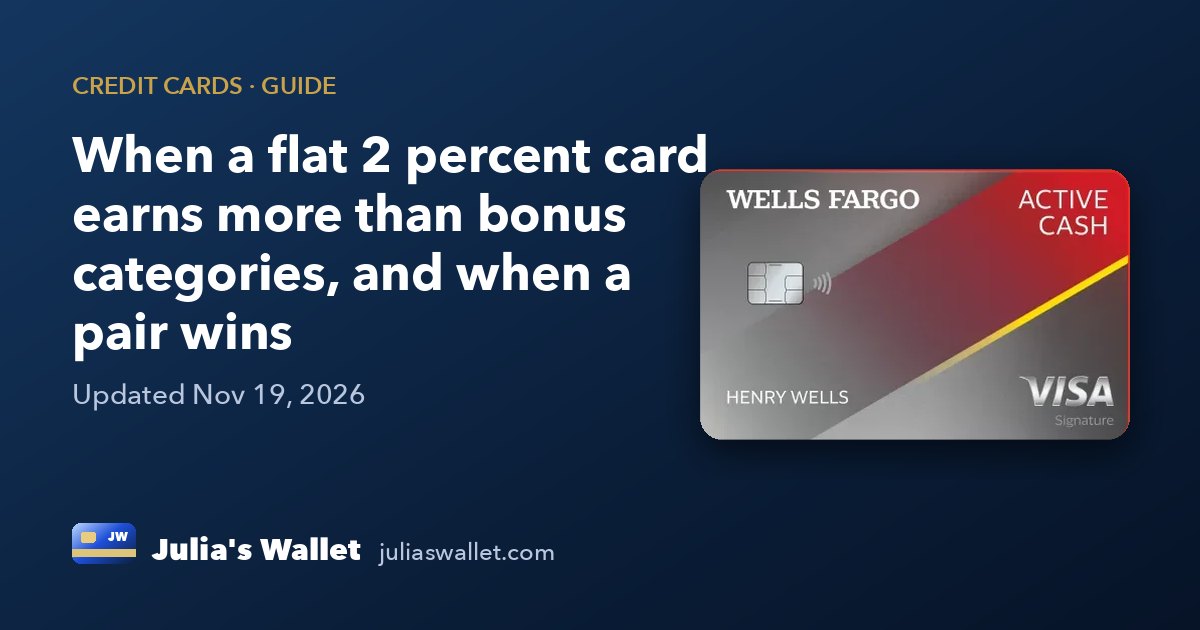
A flat 2 percent card wins as your only card unless over half your spending earns a 3 percent category rate; a category card pays more as its partner.
The short answer
As your only card, a flat 2 percent card such as Wells Fargo Active Cash or Citi Double Cash earns more than a 3 percent category card unless more than half of your spending lands in that card's categories. Each qualifying dollar gains 1 cent on the category card, and each ordinary dollar gives up 1 cent, so your split decides it.
In Julia's worked examples, category cards pull ahead when they stop trying to do everything. Capital One Savor or Blue Cash Everyday from American Express takes the purchases its 3 percent covers, and a 2 percent card takes the rest. On Savor's own budget, that pair earns $546 a year, against $420 on a flat 2 percent card alone.
Where you buy groceries can undo a category card's lead. Superstores such as Walmart and Target are excluded from Savor's grocery category, and Blue Cash Everyday's supermarket rate leaves out superstores and warehouse clubs.
How much does a flat 2 percent card earn on a normal budget?
In Julia's worked example for this comparison, a household spends each month $800 at supermarkets, $300 eating out, $250 on gas, $100 on transit, $50 on streaming and $1,200 on everything else. That is $32,400 a year, counted as a normal year with welcome bonuses left out and every reward taken as cash.
On that $32,400, Wells Fargo Active Cash earns $648 at 2 percent with no annual fee. Citi Double Cash also earns $648 with no annual fee, paid as 1 percent when you buy and 1 percent when you pay, so its full 2 percent assumes you pay off your purchases.
Category cards used alone on the same $32,400:
- Capital One Savor earns $600: $414 at 3 percent on groceries, dining and streaming, plus $186 at 1 percent on everything else.
- Blue Cash Preferred from American Express, the paid sibling of Blue Cash Everyday, keeps $643 after its regular $95 annual fee. It earns 6 percent on the first $6,000 a year at qualifying U.S. supermarkets, then 1 percent; 6 percent on select streaming; 3 percent on gas and transit; and 1 percent on the rest.
Blue Cash Preferred, a 6 percent card, finishes $5 behind Active Cash here, because its high rates reach only part of what this household buys. A big rate on a slice of your spending can lose to 2 percent on all of it.
When does a category card beat a flat card on its own?
On Capital One Savor's own budget in Julia's worked example, a family spends $600 a month on groceries, $300 on dining, $50 on eligible streaming and $100 on entertainment. That is $12,600 a year, which earns $378 on Savor at 3 percent and $252 on a 2 percent card. The family spends another $700 a month, $8,400 a year, on ordinary purchases, where Savor earns $84 at 1 percent and a 2 percent card earns $168.
Savor alone earns $462 a year, against $420 on Active Cash or Double Cash. More than half of this family's spending qualifies, so Savor wins, but only by $42.
Blue Cash Everyday works the same way. On Everyday's own budget, a household spends $7,200 a year at qualifying supermarkets, $3,600 at eligible U.S. online retailers, $2,400 at U.S. gas stations and $6,000 on everything else. Everyday pays 3 percent in each of those three categories, each with its own $6,000 annual cap, then 1 percent.
- Supermarkets earn $192: $180 on the first $6,000 and $12 on the last $1,200.
- Online retail earns $108, gas $72 and everything else $60.
That is $432 a year for Blue Cash Everyday. Double Cash earns $384 on the same $19,200, so Everyday leads by $48.
Citi Custom Cash pays 5 percent on the first $500 each billing cycle in your top eligible category, then 1 percent. At exactly $500 of groceries a cycle, Custom Cash earns $25 against $10 on a 2 percent card; over 12 cycles, $300 against $120. At $1,500 in a cycle, Custom Cash earns $35 and a 2 percent card $30. In Julia's words, Custom Cash is "a 500 dollar card, not a 5 percent card." Citi closed new applications on May 28, 2026, so Custom Cash applies only if you already hold it.
Does the store you shop at change the answer?
Yes. For Capital One Savor, moving half of the family's grocery spending, $3,600 a year, to excluded superstores costs $72. Savor alone drops from $462 to $390, which is $30 behind the $420 a flat 2 percent card earns.
For Blue Cash Everyday, if all $7,200 of groceries came from a superstore, they would earn $72 instead of $192. Everyday's year would fall from $432 to $312, and Double Cash, still at $384, would lead by $72.
Blue Cash Everyday's online rate has its own catch: it covers qualifying physical goods, not bills paid on a website. If the $3,600 of online spending were insurance or utilities, it would earn $36 at 1 percent. Everyday's year would drop to $360, and Double Cash would be $24 ahead.
Wells Fargo Active Cash pays its 2 percent on eligible purchases whatever the store's category. Citi Double Cash does too, though as a Mastercard it can't be used inside Costco.
How much does a second card add beside a flat card?
This is where category cards earn a place. The category card takes only the purchases its bonus rates cover, and the flat card takes everything else.
- On Savor's own budget: Savor on its four categories and a 2 percent card on the $8,400 of ordinary purchases earn $546, against $420 for the flat card alone. If half the groceries move to excluded superstores and those groceries go on the flat card too, the pair still earns $510, $90 more than the flat card alone.
- On Everyday's own budget: Blue Cash Everyday keeps the first $6,000 of groceries, the $3,600 online and the $2,400 of gas for $360. Double Cash takes the other $1,200 of groceries and the $6,000 of everything else for $144. Together they earn $504, $120 more than Double Cash alone.
- In the $32,400 household: Savor on groceries, dining and streaming beside Active Cash earns $786. Blue Cash Everyday on supermarkets up to its cap and gas, beside Active Cash, earns $738 before any useful subscription credit. Active Cash alone earns $648. Blue Cash Preferred beside Active Cash earns $859 after its $95 fee.
Julia's rule is to judge the extra, not the total. In the Blue Cash Everyday pair, Double Cash alone was already paying $384 of the $504. The $120 on top is what Everyday adds, and that is the figure to weigh against one more account and a cap to watch.
How do the five cards rank on Julia's Wallet Score?
Julia's Wallet Score runs from 1 to 100. Value after costs counts for 55 points, using the rewards for 20, a manageable routine for 15 and 2 specific purchase and travel protections for 10, across 3 household budgets. Five cards on her everyday card test: Savor, Active Cash, Double Cash, Blue Cash Everyday and Custom Cash.
- Capital One Savor: 76. Food spending helps, the regular categories need no activation, and its protections pay in both of Julia's tests on the current Discover-network version. The 1 percent elsewhere is its main compromise.
- Wells Fargo Active Cash: 70. A steady 2 percent with no category calendar. It earns no protection points in Julia's two tests.
- Citi Double Cash: 69. The same flat 2 percent. Its small gap behind Active Cash comes from a little spending inside Costco in Julia's standard basket, where this Mastercard can't be used.
- Blue Cash Everyday from American Express: 67. The grocery, gas and online mix helps. The caps, the monthly streaming credit and the 1 percent ordinary rate take attention, and Julia's test includes a year without that credit.
- Citi Custom Cash: 63. The $500 billing-cycle cap, then 1 percent, limits it across a whole household's spending. It is rated for existing cardholders only.
The Wallet Score rates single cards. A pair is judged by the extra dollars it adds, so a lower-scoring card can still be the better partner for your flat card if it fills your wallet's gap.
Before you act
Start with a recent statement. Add up what lands in a category card's bonus areas and what doesn't. If the categories are less than half, a flat 2 percent card on its own is likely to earn more. Then read the merchant names, because a superstore or warehouse club can take your groceries out of the bonus rate.
On each issuer's page, check:
- Capital One Savor: which purchases count as groceries, dining, entertainment and streaming, and which version of the card you would hold.
- Blue Cash Everyday: the 3 percent categories, the three $6,000 annual caps and the current streaming credit terms. American Express has also announced a new way to use Reward Dollars, depositing them into its savings account, so read its page for how that works.
- Wells Fargo Active Cash: the 2 percent rate on eligible purchases.
- Citi Double Cash: the payment requirement for the second 1 percent.
- Citi Custom Cash: whether new applications are still closed, and the $500-per-cycle cap.
Every figure here assumes you pay without interest, and welcome bonuses are left out. Terms checked October 6, 2026; rates, caps and categories may have moved since.
The cards in this guide
Keep reading
- Which cash back card pays a big family the most on groceries once the fee is out
- How the best no-annual-fee cards compare on one family budget
- When Bank of America Unlimited Cash Rewards beats Citi Double Cash, and when it doesn't
- Where a store credit card works, and how its Visa or Mastercard version differs
Terms checked Oct 6, 2026. Not financial advice.